23 Jul 2026 · 5 min read
Why Ignition became the Linux of industrial automation
ignition · scada · open-source
For nearly three decades, the industrial automation industry sold the same promise in different packaging. Every vendor claimed the fastest HMI, the best historian, the most secure gateway. Yet almost every SCADA platform shared the same DNA: expensive client licenses, Windows-only deployment, proprietary communication stacks, and architectures that locked you in the moment you drew the first screen.
The industry wasn't innovating. It was iterating.
Then in 2010, Inductive Automation — a company most plant engineers had never heard of — released something that wasn't a better SCADA. It was a different philosophy. Ignition wasn't built around HMIs. It was built around the Gateway. That one architectural decision explains nearly everything that followed — including why, fifteen years later, it's the platform the rest of the market quietly imitates.
SCADA was never the product. The Gateway was.
Ignition's biggest innovation wasn't HTML5, wasn't Perspective, wasn't MQTT support. It was moving the intelligence from the client to the server. Traditional SCADA thinks like desktop software from the nineties — fat clients, per-seat installs, a license dongle somewhere in a drawer. Ignition thinks like a web platform: everything lives on the Gateway, and a client is just a session.
Traditional · licensed per client
Gateway-centric · unlimited clients
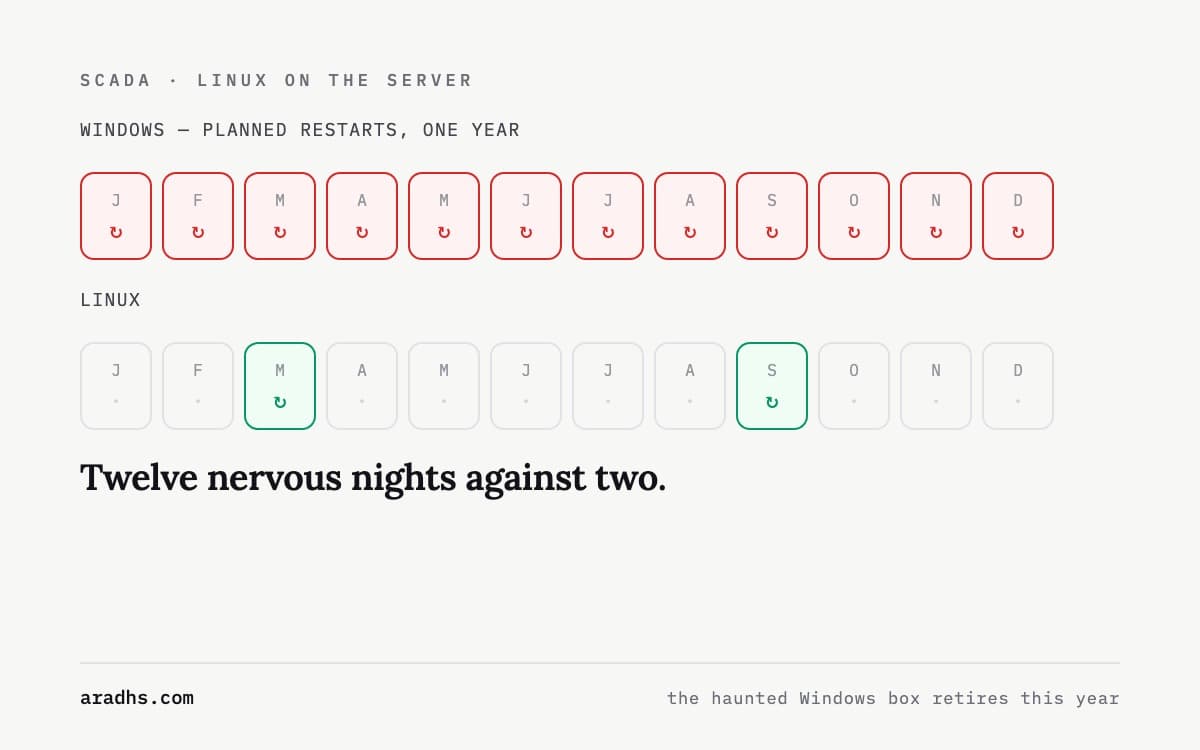
Once you see that split, the feature list stops looking like a list and starts looking like consequences. Browser clients? Of course — sessions are cheap. Cross-platform? Of course — it's a Java server, it runs the same on Windows, Linux, or a Raspberry Pi in a panel. Modular architecture? Of course — you're licensing server capabilities, not seats.
Licensing changed the economics more than the technology did
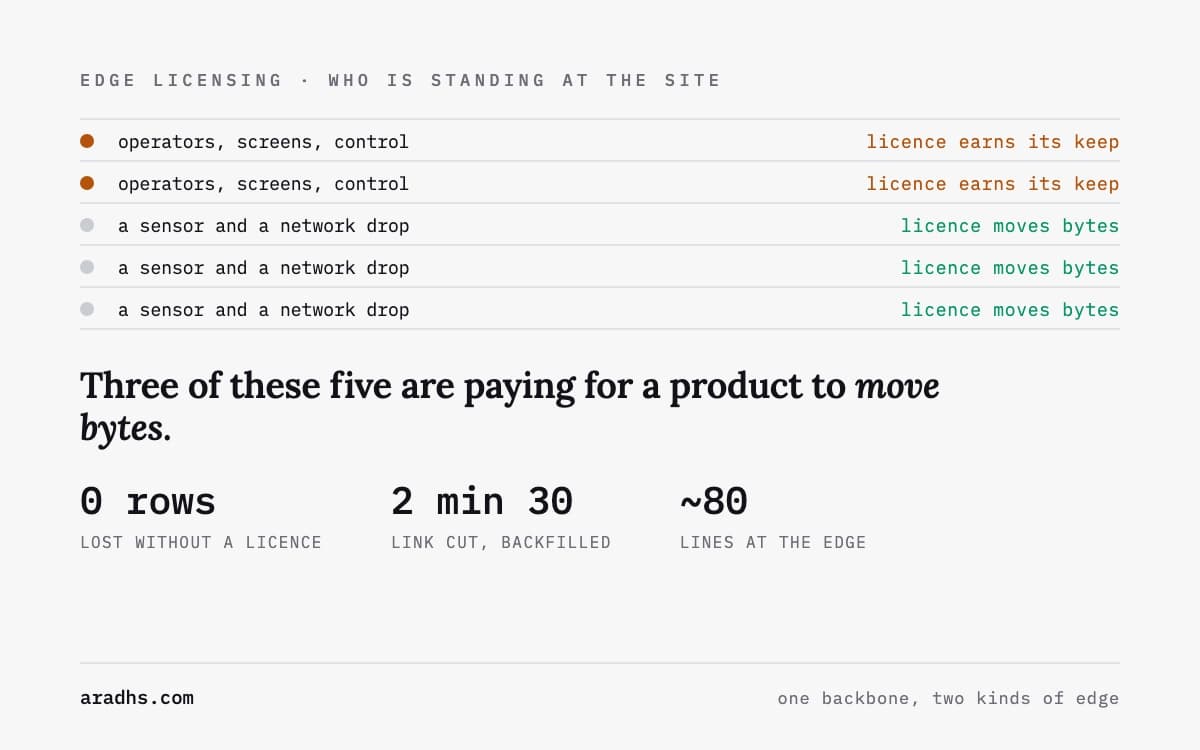
Every traditional SCADA vendor made money by counting something: screens, tags, clients, runtime seats. Ignition asked the question the incumbents structurally couldn't ask: what if we stopped charging customers every time they wanted to look at their own data? The answer became unlimited clients, unlimited tags, unlimited projects — one server license, priced by module.
Here's the contrarian read: Ignition didn't reduce software costs. It removed software from the conversation. When adding the fiftieth dashboard costs nothing, nobody writes a business case for a screen anymore — the plant just builds what it needs. That changes engineering behaviour far more than a discount would. The scarce resource stops being licenses and becomes imagination.
Why IT teams like Ignition more than OT teams do
Most automation engineers see Ignition as SCADA. IT sees something else: enterprise software that happens to speak PLC. Java. Linux. Docker. HTTPS. REST. SQL. OPC UA. Every noun on that list is something an IT department already governs, patches, monitors, and backs up.
That's the quiet reason it spreads through organizations: it sits at the narrow waist between two worlds that historically refused to learn each other's tools. IT doesn't have to learn OT's habits; OT doesn't have to learn enterprise software; the Gateway translates. If the previous essay's argument was that the platform moved from the PLC to the data architecture, Ignition is what that argument looks like as a product.
Docker changed industrial deployment, and almost nobody talks about it
The traditional SCADA install is a ritual: build a Windows box, install SQL, install the runtime, install drivers, activate licenses, reboot, pray. Then document all of it, because in five years someone will have to rebuild this machine from memory.
The old install ritual
The new one
$ docker run inductiveautomation/ignitionthen runs on
Infrastructure becomes disposable · environments become reproducible
Ignition ships official Docker images maintained by Inductive Automation, and there's an Ignition Cloud Edition on the AWS and Azure marketplaces as a pay-as-you-go image. The philosophical shift matters more than the convenience: infrastructure becomes disposable and environments become reproducible. Your gateway is a container plus a config — the same one in dev, staging, and the plant. Paired with 8.3's file-based, git-controllable projects, industrial systems finally get the workflow software teams have had for fifteen years.
One honesty note, because vendor pages blur it: Cloud Edition is not SaaS — you still own configuration, backup, and upgrades. It's your gateway on elastic infrastructure, not someone else's product.
Perspective wasn't built to replace Vision
A nuance most comparisons miss: Perspective isn't "Vision, but better." Vision is optimized for rich desktop HMIs and control-room applications — and it's still excellent at exactly that. Perspective is web-native and responsive, designed for browsers, tablets, and phones. They're built for different generations of operators, and mature deployments often run both. Treating Perspective as a mandatory migration is how you end up rebuilding a perfectly good control room for zero operational benefit.
AI readiness — the part everyone gets backwards
Every platform now claims to "have AI." The honest architecture is the opposite: Ignition doesn't need AI. AI needs Ignition's data.
What an LLM or a predictive model needs from the plant is structured, contextualized, current data — named tags, units, hierarchy, history. That's precisely what a well-built Gateway already exposes through SQL, REST, MQTT, and the historian. The AI itself belongs outside the SCADA: in the data platform, where models can iterate at software speed without touching anything that keeps the plant running. Platforms that embed proprietary "AI features" inside the SCADA are repeating the exact bundling mistake that open architectures just spent a decade unwinding.
The honest comparison
| Platform | Biggest strength | Biggest weakness |
|---|---|---|
| FactoryTalk (Rockwell) | Deepest Rockwell integration | Licensing complexity |
| WinCC (Siemens) | Siemens ecosystem fit | Windows-centric (Unified is changing this) |
| AVEVA System Platform | Enterprise-scale features | Cost and heft |
| AVEVA Plant SCADA (ex-Citect) | Maturity, install base | Legacy architecture |
| Ignition | Open platform, licensing, deployment | Advanced projects demand real IT/web skills |
That last cell is the fair criticism worth keeping: Ignition's ceiling is higher, but so is the skill floor for reaching it. Python scripting, SQL, web concepts, containers — a team that only knows ladder logic will find Perspective a steeper hill than a legacy HMI package. The platform assumes you're becoming a software team. Not every integrator wants to be one.
The takeaway
Ignition didn't become popular because it was a better SCADA. It became popular because it stopped behaving like SCADA software — and started behaving like a modern software platform that happens to control factories. Gateway-centric architecture, unlimited server licensing, open protocols, containers, git-able projects: none of these are "features" in the traditional sense. They're a mindset imported from the software world into an industry that had stopped expecting it.
That's why "the Linux of industrial automation" fits. Not because it's open source — it isn't — but because it won the same way Linux did: by being the platform that respected its users' intelligence, ran anywhere, and let the ecosystem build the rest.
The future of industrial software isn't a faster PLC or a smarter SCADA. It's industrial systems that behave like cloud-native software. Ignition's most enduring innovation is that it made an entire industry expect that.
Evaluating a SCADA migration, or arguing with a vendor about licensing right now? Tell me about it.
Keep reading
Newsletter
New essays, by email.
SCADA, cloud, AI, and the plant floor — a short email when something new is published. No noise, unsubscribe anytime.