Concluded·31 Jul 2026 · 5 min read
Ten million plant readings on one small box, and the mistake that cost 5.6×
Node.js 20 · TimescaleDB pg17 · Mosquitto 2 · Docker Compose · Proxmox LXC
Before anyone buys storage for a historian, somebody usually runs a load test. I wanted to know what a good one looks like, so I built the generator, then tried to break my own numbers.
Two things came out of it that I did not expect, and one of them would have cost real money.
What the generator produces
Six kinds of tag, mixed so that slow analogue values dominate as they do on a real site: temperature, flow, pressure, vibration, a production counter and a discrete state. Ten thousand tags, one-second sampling.
The models are deliberately not noise:
| Kind | Behaviour |
|---|---|
| temperature | slow drift, a daily cycle, a step at shift change |
| flow | flat at zero, then flat at rate, when a pump starts |
| pressure | follows flow, with its own small noise |
| vibration | quiet, occasional spikes, a slow creep on ~1 asset in 23 |
| counter | monotonic, never decreases |
| state | discrete, holds for hours |
WHAT PLANT DATA ACTUALLY LOOKS LIKE
Every value is a pure function of (seed, tagIndex, sampleIndex), so a run
reproduces exactly and nothing has to be stored to repeat it. That matters more
than it sounds: it means the ClickHouse comparison later can be fed byte-identical
data without shipping a dataset around.
Where the time goes
One million readings through each stage, single process, each row adding the next real cost:
| Stage | Points/sec |
|---|---|
| work out the values | 3,164,557 |
| + serialise to JSON | 1,158,749 |
| + publish over MQTT | 211,193 |
+ batched multi-row INSERT | 166,722 |
+ COPY, a row at a time | 54,888 |
+ COPY, in 2,000-row chunks | 309,502 |
ONE MILLION READINGS, ONE PROCESSOR CORE
Buffering the rows and writing two thousand at a time made it 5.6 times faster and moved it from slowest to fastest. Nothing about the database changed.
Producing the readings is nearly free. A single core makes over three million a second, and JSON costs about two thirds of that (62 MB of text per million readings). MQTT publishing dropped it to 211,000 and, worth noting for anyone load-testing a broker, resident memory climbed to 706 MB as the client buffered ahead of the socket.
The mistake, and the wrong guess before it
COPY is supposed to be the fast path into Postgres. Mine came out three times
slower than ordinary batched inserts, which is the wrong way round and therefore
worth chasing rather than reporting.
First guess, reasonable, wrong. Every tag in a sample shares one timestamp, and the code was rebuilding the ISO string once per reading rather than once per sample. Hoisting it out of the inner loop took 49,945 → 54,888. Real, about ten per cent, and not the answer.
The actual cost was one stream.write() per reading. Each write carries the
same fixed overhead whether it holds forty bytes or forty thousand, and I was
paying it ten million times over, plus a backpressure check each time. Buffering
rows and writing in chunks:
| Chunk size | Points/sec |
|---|---|
| a row at a time | 54,888 |
| 500 | 295,508 |
| 2,000 | 309,502 |
| 20,000 | 280,112 |
5.6× faster, and it moved COPY from the slowest option in the table to the
fastest. Chunk size barely matters past a few hundred, so there is no tuning
exercise here — there is just one thing you must not do.
The general lesson is the one I keep relearning: when a well-known fast path measures slow, the tool is usually fine and the loop around it is not.
More cores barely helped
Two million readings, varying worker processes. Node runs one thread, so parallelism means separate processes, each owning a disjoint slice of tags.
| Workers | Points/sec |
|---|---|
| 1 | 304,414 |
| 2 | 287,936 |
| 4 | 352,734 |
| 6 | 397,772 |
ADDING CORES TO A DATABASE PROBLEM
Six cores bought 1.31×. Two workers were briefly worse than one. The
generator can produce 3.1 million readings a second on one core while six
parallel COPY streams land 398,000, which puts the ceiling somewhere it is
easy to misattribute.
THE CONSTRICTION
If a load test is running too slowly, a bigger box for the generator will do almost nothing. The database is the constriction.
The full run
| Points | 10,000,000 |
| Workers | 6 |
| Time | 26.1 s |
| Rate | 382,555 points/sec |
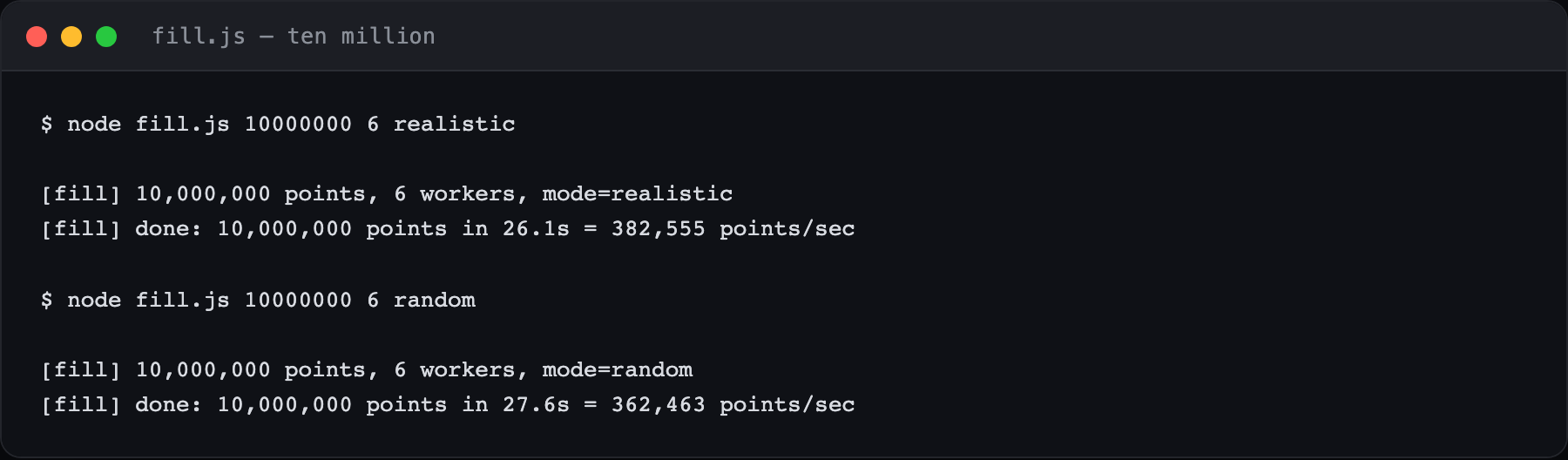
On a shared box with several other containers running. Simulating a plant's worth of history is not a hardware problem.
The finding that costs money
Two identical tables. Same schema, same 10,000,000 rows, same database, same compression settings. One holds plant-shaped data; the other holds uniform random numbers, which is what a quickly-written generator emits.
| Arm | Raw | Compressed | Ratio | Bytes per reading |
|---|---|---|---|---|
| shaped like a plant | 695 MB | 16.2 MB | 43.0× | 1.69 |
| uniform random | 696 MB | 81.7 MB | 8.5× | 8.57 |
10,000,000 READINGS, COMPRESSED
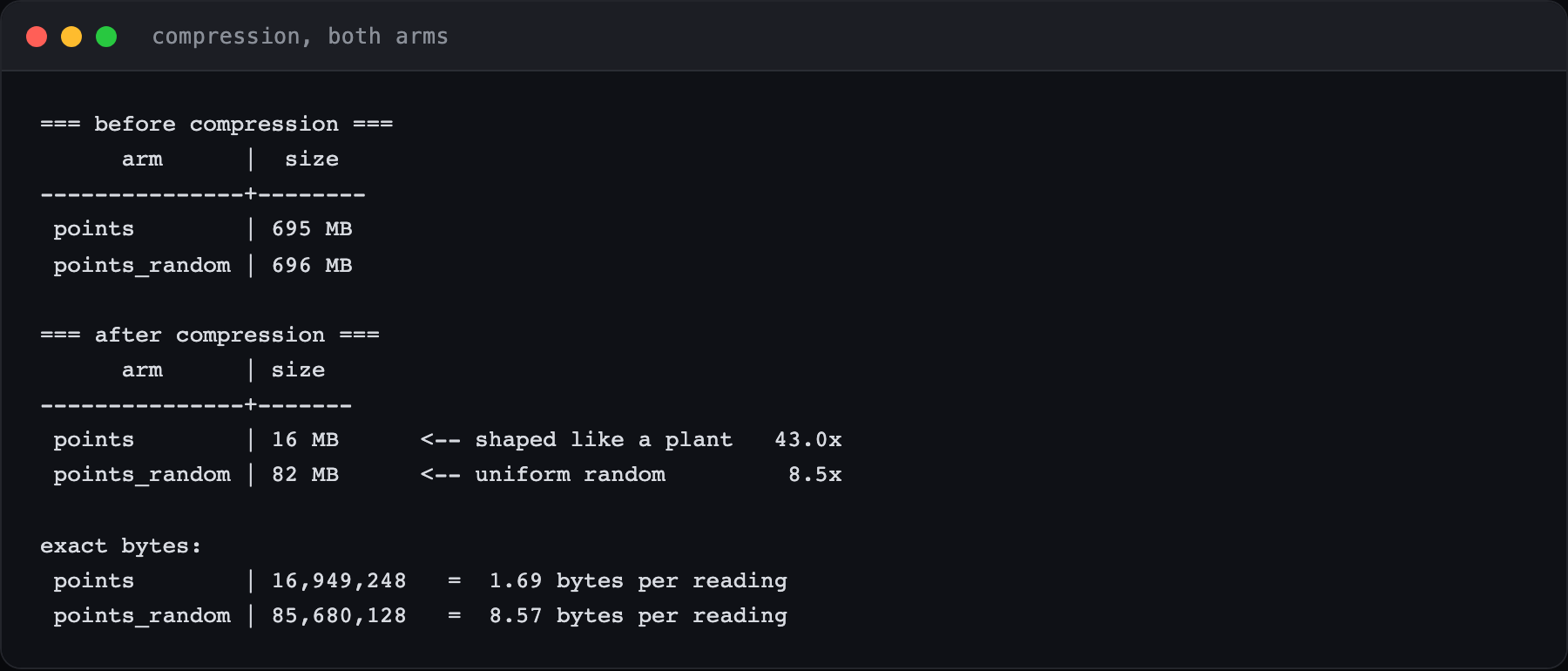
Compression works by finding repetition. Plant data is full of it — states that hold, counters that step by a constant, analogues that wander between neighbouring values. Random numbers contain none, so there is nothing to remove.
A load test built on noise understates compression by five times. It is not an obviously broken test. It runs, it produces a number, and the number is confidently wrong in the direction that makes you buy hardware.
THE NUMBERS WORTH REMEMBERING
At 1.69 bytes per stored reading, one tag sampled every second for a year is about 53 MB. A thousand of them, roughly 53 GB a year.
What I would tell someone repeating this
Model the shape, not the statistics. You do not need a physics model; you need values that hold still, values that step, and counters that only climb. That is an afternoon of work and it is the difference between a storage estimate you can sign and one that is out by five times.
Write in chunks. Check your loading loop before you blame the engine.
And do not buy a bigger machine for the generator. It was idle.
What this feeds
The ten-million-row table is the input for the ClickHouse against TimescaleDB comparison, so both engines get measured on identical, realistically shaped data rather than on noise.
The argument, without the measurements, is in the article.
Newsletter
New essays, by email.
SCADA, cloud, AI, and the plant floor — a short email when something new is published. No noise, unsubscribe anytime.